
The Male Allyship Continuum
The male allyship continuum: how men move from awareness to change
In a world that feels increasingly unpredictable, conversations about equality can stir up strong emotions. Some men feel unsure of their place in the discussion, others fear getting it wrong, and many genuinely want to help but don’t know where to begin.
At Male Allies UK, we’ve spent years helping men and organisations navigate this landscape. Through that experience, we developed our Male Allyship Continuum – a model that helps us understand where men are on their allyship journey and how to support them in moving forward.
The continuum recognises that allyship isn’t a single moment of enlightenment. It’s a process of growth that unfolds over time, shaped by awareness, emotion, and action. Just as Prochaska and DiClemente’s Stages of Change model explains how individuals move from resistance to sustained transformation, our continuum offers a practical framework for change in the context of gender equity.
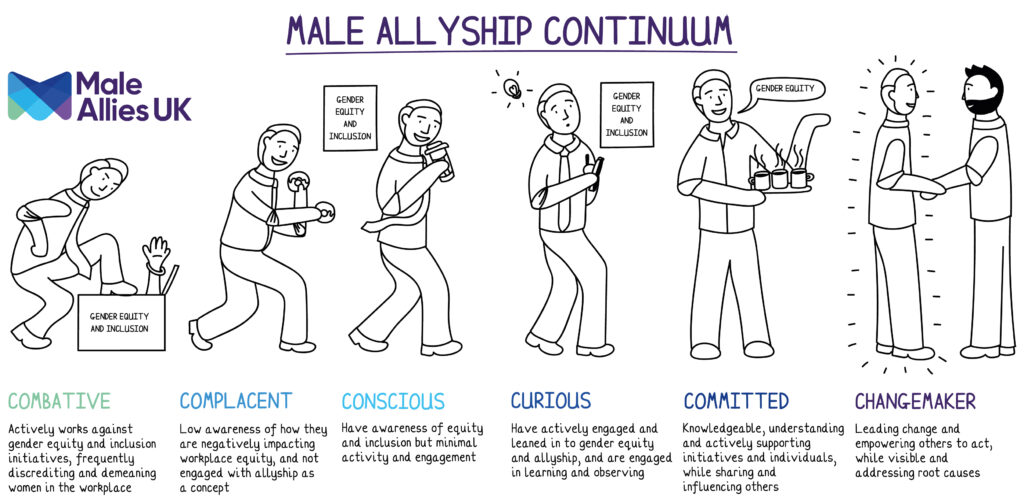
The 6 stages of the continuum
Stage 1: Combative – Resistance and fear
At the first stage, men may feel that gender inclusion threatens their identity or status. They might express frustration that “everything’s changing too fast” or claim that equity initiatives are “anti-male.”
In our work, we approach this resistance with curiosity rather than judgement. Often, these men are operating from scarcity – feeling unseen, over-stretched, or uncertain about their own role in a changing world. Their frustration is real, but misplaced.
The combative emotions here are fear and loss of control. Our role is to help them name those feelings, to separate their personal struggles from the broader narrative of inclusion, and to begin reframing equity not as a zero-sum game but as a collective gain
Stage 2: Complacent – The comfort of unawareness
Many men aren’t combative; they’re simply unengaged. They believe in fairness in principle but haven’t reflected on how gender dynamics play out in daily decisions – who speaks in meetings, who’s interrupted, who’s promoted, and so on.
At this stage, the emotion is comfort. When the world feels fine as it is, it’s easy to become complacent. But this can mask complicity.
We work with organisations to gently surface these blind spots through data, discussion, and storytelling. When men start noticing patterns – who gets credit, who gets overlooked – curiosity begins to replace indifference.
Stage 3: Conscious – Seeing the system
Conscious men have begun to connect the dots. They’ve attended training, read articles, or listened to women’s experiences. Awareness has started to dawn – but action still feels risky.
Emotions here range from guilt to uncertainty. Many tell us, “I want to help, but I don’t want to say the wrong thing.”
At this point, we focus on building confidence through learning. We help men understand that missteps are part of the journey, not evidence of failure. Awareness without action is only half the story; the next step is curiosity.
Stage 4: Curious – Leaning in and learning
Curious allies start engaging more intentionally. They ask questions, attend sessions, observe dynamics, and reflect on feedback. They’re open to challenge and hungry to understand.
This is a hopeful stage – defined by learning and humility. But it can also be uncomfortable. Recognising privilege and bias can trigger defensiveness or self-doubt.
Our role here is to create psychological safety for learning. We facilitate spaces where men can practise allyship – speaking up in meetings, giving credit publicly, or challenging bias in real time – supported, not shamed. Curiosity becomes the bridge to commitment.
Stage 5: Committed – From awareness to action
Committed allies don’t just support inclusion – they live it. They mentor and sponsor women, challenge biased decisions, and share what they’ve learned with peers.
The emotion at this stage is purpose. These men understand that allyship is an active choice, not a passive belief. They’re beginning to use their influence to shift culture – amplifying underrepresented voices, advocating for fair pay, and reinforcing inclusive policies.
We equip committed allies with the tools to extend their impact: peer coaching, data-driven storytelling, and strategies for influencing senior leaders. The work now is to sustain momentum and model accountability.
Stage 6: Changemaker – Leading systemic change
At the top of the continuum sits the Changemaker – someone who uses their platform to transform not just behaviour but systems. Changemakers focus on structures, not individuals. They recognise that inequality is sustained by processes – recruitment, pay, promotion, visibility – and they act to dismantle those barriers.
The defining emotion is conviction. Changemakers understand that allyship isn’t about being right – it’s about doing right, even when it’s uncomfortable.
They empower others to act, mentor new allies, and build accountability into policy. They don’t wait for perfect conditions; they sustain progress through disruption, ensuring that gender balance remains a strategic priority even in turbulent times.
As one of our clients put it, “The goal isn’t perfection; it’s persistence.”
How we support the journey
At Male Allies UK, we meet men where they are – without judgement, without shame, and without lowering the bar for change.
Coupled with our CAUSES framework, our programmes are designed to move men step by step along this continuum:
- For the Combative and Complacent, we focus on listening, empathy, and reframing inclusion as shared success.
- For the Conscious and Curious, we build skill and confidence through reflective learning, dialogue, and practical application.
- For the Committed and Changemaker, we develop leadership capability – mentoring, sponsorship, and systemic advocacy.
Across every stage, we integrate insights from psychology, leadership theory, and lived experience. As Prochaska showed, change sticks when people feel seen, supported, and accountable. Allyship follows the same pattern: awareness → reflection → action → reinforcement.
We also work directly with organisations to embed this continuum into their DEI strategies – helping HR, DEI, and gender–network leads to identify where their male colleagues are, and what support each group needs next.
The result? More men moving from awareness to advocacy, and more organisations building inclusive systems that last.
Why this work matters now
In dynamic times, inclusion can feel like one more challenge on an already crowded agenda. But it’s precisely in uncertainty that allyship matters most.
When workplaces are under pressure, people default to the familiar – which can mean exclusionary habits return. Having visible, confident male allies keeps equity on the table, even when attention drifts elsewhere.
That’s why our Male Allyship Continuum isn’t just a model; it’s a roadmap for resilience. It helps organisations sustain progress, prevent regression, and keep gender balance at the heart of how business is done.
A journey we take together
Every man sits somewhere on this continuum. What matters is not the starting point, but the willingness to move.
If you recognise your organisation – or yourself – in any of these stages, know that progress is possible. The journey takes courage, support, and reflection, but the rewards are profound: more trust, better collaboration, stronger teams.
At Male Allies UK, we’re proud to guide that journey – helping men transform uncertainty into influence, and influence into lasting change.
Your questions answered
Why is male allyship important for organisations today?
In dynamic times, inclusive workplaces thrive. Male allyship strengthens teams, drives fairness, and ensures women’s progress isn’t left to chance. When men actively champion equality, organisations see better collaboration, retention, and innovation – and a culture where everyone belongs and contributes fully.
What is the male allyship continuum?
The male allyship continuum is our evidence–based model that maps how men progress from resistance to changemaking. It helps organisations understand where men are on their allyship journey and guides tailored support to move them forward – from awareness to action, and ultimately, to leading systemic change.
How does Male Allies UK support men through this journey?
We meet men where they are. Through workshops, coaching, and leadership development, we help them build confidence, empathy, and skill at every stage of the continuum. Our programmes create safe spaces to learn, practise allyship, and turn intent into lasting cultural impact.