
The Three Levels of Allyship
Individual, leader, and organisational
At Male Allies UK, we see allyship operating across three interconnected levels. When all three are active, allyship becomes consistent, credible, and sustainable.
Individual allyship isn’t less valuable because it’s not changing systems – it’s a skillset that’s being developed on the path to making systemic change happen.
Think about it: it’s not often someone can jump straight into making organisational change happen. A foundation of individual allyship is required first – working on yourself and getting used to taking small, individual action.
This foundation of confidence and competence allows you to move onto weaving your allyship through your leadership, influencing culture and systems within your team and senior leadership.
Once you have your individual and leader allyship down, you’ll be ready to move onto organisational allyship, changing systems within your workplace to ensure equity is built in.
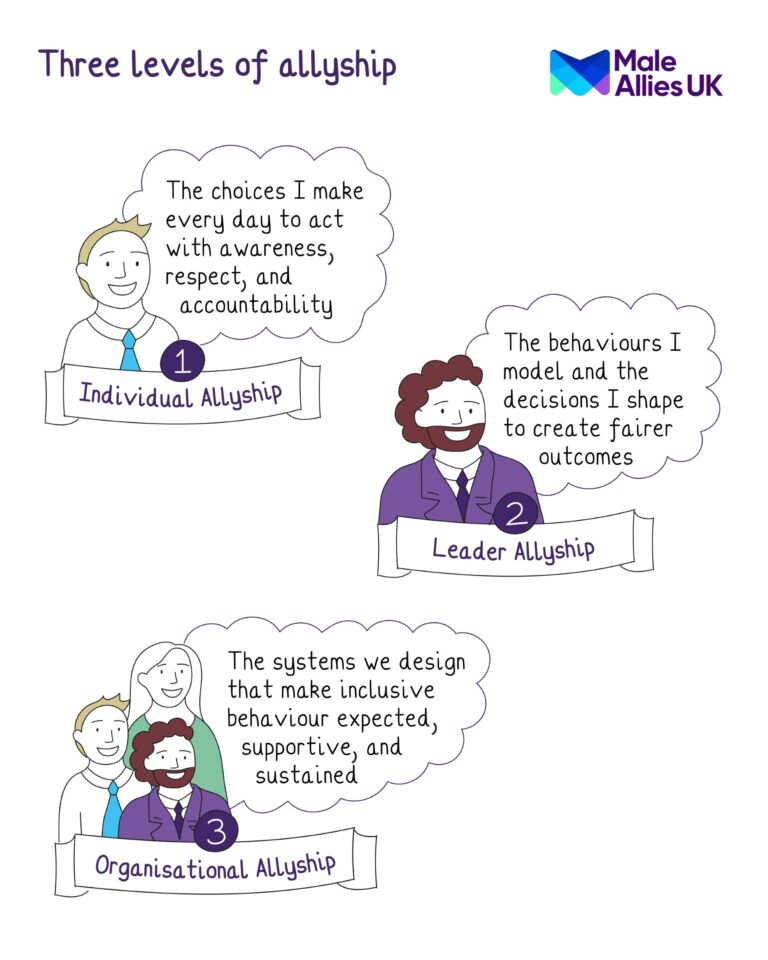
1. Individual allyship
“What I do, say, and learn – every day.”
Everyone has a role to play. Allyship starts with personal responsibility, everyday behaviours, and a willingness to act in the moment.
What this looks like
- Speaking up when something doesn’t feel right
- Returning airtime in meetings (“Let’s go back to…”)
- Giving clear credit and attribution
- Challenging “banter” constructively
- Listening to understand, not to defend
- Reflecting on your own behaviour and impact
Common risk
- Good intentions without action
- Fear of getting it wrong leading to silence
Skills being built
- Awareness → recognising bias or exclusion
- Courage → acting despite discomfort
- Communication → calling in, not just calling out
Individual allyship is where people start, but it cannot carry the system alone.
2. Leader allyship
“What I enable, model, and prioritise.”
Leaders shape culture through what they prioritise, reward, and tolerate. Their allyship carries more weight because of their position and influence.
What this looks like
- Role-modelling inclusive behaviour consistently
- Sponsoring talent into visible, career-defining work
- Challenging bias in hiring, promotion, and pay decisions
- Setting expectations for respectful behaviour
- Intervening when issues arise, not delegating it
- Creating space for different voices to be heard
Common risk
- Saying the right things but not changing decisions
- Delegating inclusion to HR or networks
Levers leaders control
- Access (who gets opportunities)
- Visibility (who gets seen and recognised)
- Protection (who feels safe to contribute)
Leader allyship turns allyship from personal behaviour into cultural signal.
3. Organisational allyship
“What the system makes possible, or difficult.”
Organisations create the conditions that either support or undermine allyship. Systems determine whether allyship is easy, risky, or inconsistent. carries more weight because of their position and influence.
What this looks like
- Fair, transparent hiring and promotion processes
- Clear reporting mechanisms for inappropriate behaviour
- Psychological safety to learn, speak up, and make mistakes
- Inclusive policies (flexibility, parental leave, progression)
- Measurement of behaviour, not just representation
- Accountability embedded into leadership expectations
Common risk
- Relying on individuals to ‘do the right thing’
- Inconsistent responses that erode trust
System signals
- What gets rewarded
- What gets challenged
- What gets ignored
Organisational allyship determines whether individual and leader efforts are sustained or slowly eroded.
All three levels are needed to make change happen
All three levels of allyship are needed for any organisational change to be made. Organisations that are fair, inclusive, and gender-equitable do not stop at the individual level and consider the job done.
To get to the desired level of systemic change, individual behaviour and culture change must happen first. They must also continue to feed into the organisation and systems, rather than being left behind once the systemic level has been reached.
How the three levels work together
- Individuals act, which creates moments of inclusion
- Leaders reinforce, which turns moments into norms
- Organisations embed, which turns norms into systems
Most organisations focus on one level, but effective allyship requires all three.
If individuals act but leaders don’t reinforce → progress stalls.
If leaders act but systems don’t support → progress fades.
If systems exist but individuals don’t engage → progress feels forced.