
The CAUSES framework
How Our CAUSES Framework Builds Confident and Committed Male Allies
Creating change takes more than awareness. It takes structure, motivation, and support.
We’ve seen time and again in our work that even well-intentioned men can struggle to translate belief into action. Whether it’s not knowing how to start or lacking the resilience and drive to continue when it gets uncomfortable, good intentions alone aren’t enough to start the ball rolling or keep the momentum going.
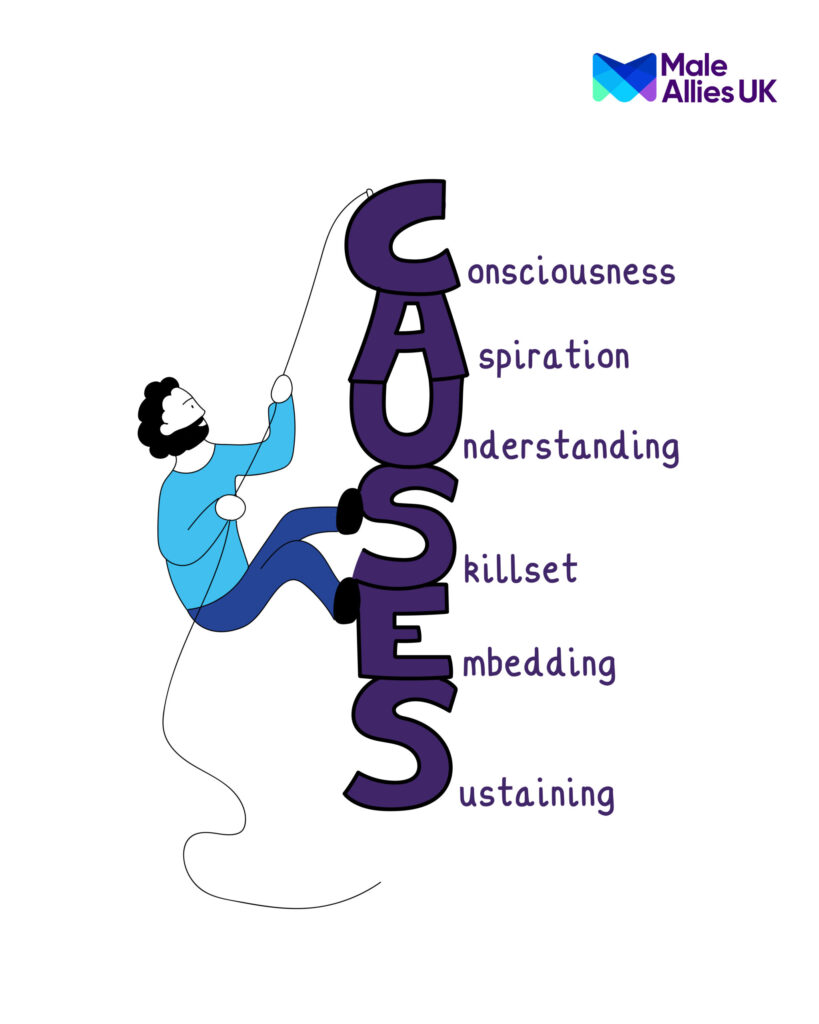
That’s why we developed the CAUSES Framework – a practical, human-centred roadmap for developing confident, consistent male allies.
Consciousness
Aspiration
Understanding
Skillset
Embedding
Sustaining
This framework helps men connect their values to everyday behaviours and sustain their growth, even after we’ve left the organisation. Read on to find out more about it.
The psychology behind CAUSES
Real behaviour change is rarely linear. People don’t transform simply because they’re told to – they grow when they both understand their motivation and feel equipped to act.
Self-Determination Theory (Deci & Ryan) shows that lasting learning happens when three needs are met:
- Competence – being capable and effective
- Autonomy – having choice and control over your life
- Relatedness – feeling connected to others, part of something bigger
CAUSES reflects these principles. It starts with self-awareness, builds skill and confidence, and ends with belonging. Thereby embedding allyship into teams and systems – so it becomes part of organisational DNA.
Research from Warren (2022) and Moser (2024) supports this progression: men sustain allyship when they link personal purpose to collective impact and have spaces to practise, reflect, and connect. That’s exactly what CAUSES creates.
The 6 stages of CAUSES
1. Consciousness – Seeing the system
What it means:
Change begins with awareness – noticing bias, inequity, and everyday patterns that shape who is heard, hired, or promoted.
What it looks like:
Through stories, data, and dialogue, we help men see how gender dynamics show up in their world. For some, this is the first time they’ve recognised invisible barriers.
What your team may be feeling:
Surprise, discomfort, curiosity.
Our role:
We create safe learning spaces to observe without shame – because awareness is the spark that ignites allyship.
2. Aspiration – Finding your “why”
What it means:
Awareness alone doesn’t drive action. Aspiration connects insight to intent. Men identify their why – the reason allyship matters to them personally and professionally.
What it looks like:
Values–based exercises and honest discussion about fears and motivation. Many discover allyship aligns with the kind of leader, colleague, or parent they want to be.
What your team may be feeling:
Hope, vulnerability, and sometimes apprehension – the recognition that growth will require courage.
Our role:
We help men articulate their goals so they have an internal compass to guide them through challenge and discomfort.
3. Understanding – Deepening insight
What it means:
Understanding moves from what happens to why it happens. Men learn about systemic bias, intersectionality, and lived experiences beyond their own.
What it looks like:
Interactive discussions, case studies, and reflective dialogues with colleagues. Participants begin to connect structural barriers to everyday behaviour.
What your team may be feeling:
Empathy, humility, sometimes guilt – which we help transform into energy for change.
Our role:
We use insights from Warren and Moser’s research to normalise this stage: empathy increases when learning is relational and experiential. We pair knowledge with practice so men don’t stall in reflection.
4. Skillset – Turning insight into action
What it means:
Allyship is a skillset – not a slogan. This stage focuses on practical tools for speaking up, intervening, and influencing culture.
What it looks like:
Scenario–based training, peer practice, and role–plays that simulate real workplace dynamics. Participants learn to challenge bias, give feedback, and sponsor others effectively.
What your team may be feeling:
Nervousness shifting to confidence.
Our role:
We provide scripts, language, and coaching. Building competence is essential – it’s what turns intention into visible behaviour.
5. Embedding – Making allyship systemic
What it means:
Embedding moves allyship beyond the individual. It’s about integrating inclusive practices into policies, processes, and team culture.
What it looks like:
Updating performance reviews to reward inclusive leadership, creating peer accountability networks, and weaving allyship into leadership expectations.
What your team may be feeling:
Pride and ownership. Men begin to see that culture change isn’t abstract – it’s built one process, one conversation at a time.
Our role:
We partner with HR, DEI, and gender–network leads to align systems with behaviour. This is where the CAUSES framework connects naturally with our Male Allyship Continuum – translating individual readiness into organisational movement.
6. Sustaining – Keeping momentum alive
What it means:
Allyship isn’t a one–off initiative; it’s a lifelong practice. Sustaining means maintaining progress, preventing regression, and bringing others along.
What it looks like:
Peer mentoring, regular reflection sessions, measuring progress, and celebrating wins. Men evolve from participants to mentors – helping new allies start their journey.
What your team may be feeling:
Commitment and purpose.
Our role:
We create communities of practice where men stay connected and accountable. The result is cultural durability – allyship that endures through leadership changes and market shifts.
How organisations use the CAUSES framework
We’ve implemented CAUSES across industries – from finance to healthcare – adapting each stage to the needs of the organisation. Some organisations use it to structure a year-long allyship programme; others embed it into leadership development or employee-network strategies. Our male allyship continuum also helps organisations understand the different stages – ranging from combative to curious to committed – the men in their organisation will be, using CAUSES and the continuum together.
Because each stage is measurable, HR and DEI teams can assess progress and see tangible impact: more men actively sponsoring women, increased speaking up behaviour, and clearer accountability for inclusion.
In times of uncertainty, CAUSES provides stability – a roadmap that keeps equity work moving even when priorities compete for attention.
A journey powered by purpose
Sustainable allyship grows when men feel ownership, capability, and connection. The CAUSES Framework nurtures all three. It helps individuals recognise where they are, discover why it matters, and practise how to make inclusion real. Every day, in every role.
If your organisation wants to turn intention into consistent, confident action, we’re here to help. Together, we can build workplaces where allyship isn’t exceptional – it’s expected.