
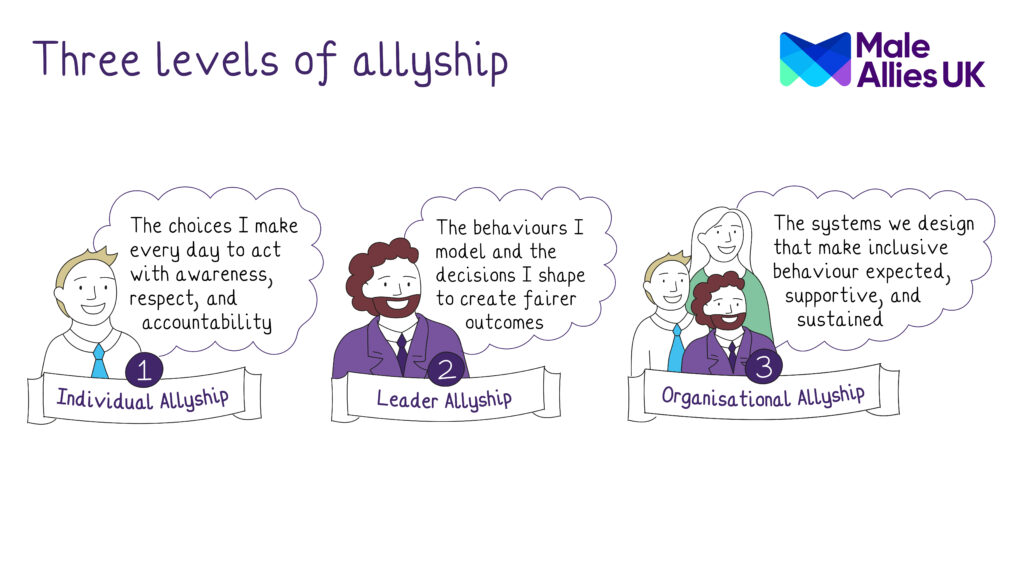
Conversations around allyship tend to revolve around the individual element. While speaking up for others at work is important, it’s not the only type of allyship there is. Despite strong starts, allyship fails when organisations aren’t aware of the three levels of allyship: individual, leader, and organisational.
When the three levels aren’t working together, organisations find that allyship starts strong with some invested individual allies, but it soon fades. This isn’t because people don’t care, it’s because the conditions around them don’t support it. At Male Allies UK, we believe the problem isn’t a lack of intent – it’s a lack of infrastructure.
The problem with how we think about allyship
Most organisations focus on allyship as an individual responsibility. They ask people to:
- Be more aware
- Speak up
- Challenge behaviour
- Support colleagues
All of which matters. But this creates an unspoken expectation that individuals should carry the weight of culture change on their own. That’s where things start to break down. Because allyship doesn’t happen in isolation, it needs to be embedded into the leadership and organisation.
The three types of allyship
To understand what actually makes allyship work, we need to look at it across three levels.
Individual allyship: what people do
This is the most visible form of allyship. It’s what happens in meetings, conversations, and everyday interactions. It looks like:
- Returning airtime when someone is interrupted
- Giving credit where it’s due
- Challenging inappropriate comments
- Listening to understand
- Reflecting on your own behaviour
This is where allyship begins, but it’s also where it most often gets stuck. Because acting in the moment requires confidence, competence, and a sense that it’s safe to do so. Without that, even well-intentioned people hesitate or lose momentum over time.
Leader allyship: what gets reinforced
Leaders play a different role. They don’t just participate in culture – they shape it. Their actions signal:
- What is acceptable
- What is expected
- What gets rewarded
- What gets challenged
Leader allyship is therefore an integral component to inclusion. It looks like:
- Sponsoring people into meaningful opportunities
- Challenging bias in hiring and promotion decisions
- Intervening when behaviour crosses a line
- Role modelling inclusive behaviour consistently
- Creating space for different voices to be heard
This is where allyship becomes visible at scale. When leaders don’t act, something important happens: people notice. And they adjust their behaviour accordingly.
Organisational allyship: what gets sustained
The third level is often the least visible but it’s the most powerful. Organisational allyship is about systems. It’s about whether the organisation makes allyship easy, difficult, or inconsistent. This includes:
- How people are hired and promoted
- Whether reporting mechanisms feel safe and fair
- Whether policies support different life circumstances
- Whether inclusive behaviour is measured and expected
This is where allyship either becomes part of how things are done – rather than remaining dependent on individuals. Individuals can only be active allies when the leadership and organisation enables them to do so.
Why allyship fails
When these three levels are not aligned, allyship struggles. You might have:
- Individuals who want to act, but don’t feel safe
- Leaders who say the right things, but don’t change decisions
- Systems that reward performance, but ignore behaviour
Over time, this creates a gap between intention and experience. People begin to disengage. Not because they’ve stopped caring, but because the effort doesn’t feel supported or worth the risk.
The role of allyship infrastructure
This is where Allyship Infrastructure becomes critical. Allyship Infrastructure is the combination of:
- Conditions
- Behaviours
- Systems
That make allyship possible and sustainable. It ensures that allyship is not left to chance. Instead, it creates an environment where people know what to do, leaders reinforce it, and systems support it.
Think of it like this:
- Individual allyship creates moments
- Leader allyship creates momentum
- Organisational allyship creates consistency
What this means for organisations
If you want allyship to work, the focus needs to shift from ‘Are people being good allies?’ to ‘Have we made it possible for people to act like allies?’
That means:
- Building practical skills, not just awareness
- Supporting leaders to act, not just endorse
- Designing systems that reduce bias and increase fairness
- Creating psychological safety to learn, speak up, and sometimes get it wrong
Because allyship isn’t about perfection. It’s about progress that can be sustained.
A more realistic view of allyship
Allyship is not a single action, it’s not a one-off moment, and it’s not something that can be solved through training alone. It’s a capability that develops over time. And like any capability, it depends on the environment it sits within.
When the environment supports it, allyship grows. When it doesn’t, even the most motivated individuals begin to step back.
The key question
For organisations, the question is simple: are we relying on individuals to carry allyship? Or are we building the infrastructure that allows it to thrive?
Because the difference between the two is what determines whether allyship lasts. Allyship doesn’t fail because people don’t care. It fails when the system around them makes it too hard to succeed.