
The Male Allies UK Allyship Framework
Male allyship that lasts: The MAUK framework for sustainable allyship
Male allyship is everywhere right now. Statements. Campaigns. Training sessions. Good intentions.
But too often, organisations are left asking the same question a year later: “Why hasn’t anything really changed?”
At Male Allies UK, we work with a simple but often overlooked truth: Allyship doesn’t fail because men don’t care. It fails because it isn’t designed to last.
That’s why our work focuses on sustainable male allyship – allyship that holds under pressure, adapts as people grow, and stays effective long after the initial motivation fades.
This page brings together the core ideas behind our approach. It’s the foundation of our work with organisations, leaders, and men at every stage of the allyship journey.
Why male allyship needs a different approach
Most inclusion efforts focus on what men should do. Far fewer focus on:
- How allyship is experienced by others
- How it changes over time
- How power, confidence, fear, and identity shape behaviour
- How organisations either support or silently erode allyship
The result is predictable:
- Early enthusiasm followed by withdrawal
- Men stepping back at the first mistake
- Over-reliance on a small group of “safe” allies
- Frustration from women and marginalised groups
- Leaders unsure how to intervene without making things worse
Male allyship doesn’t need more motivation. It needs better structure, skills, and support. This is where our framework comes in.
The MAUK Allyship Framework
Our work is built around a set of interconnected concepts that help allyship move from intention to impact – and stay there.
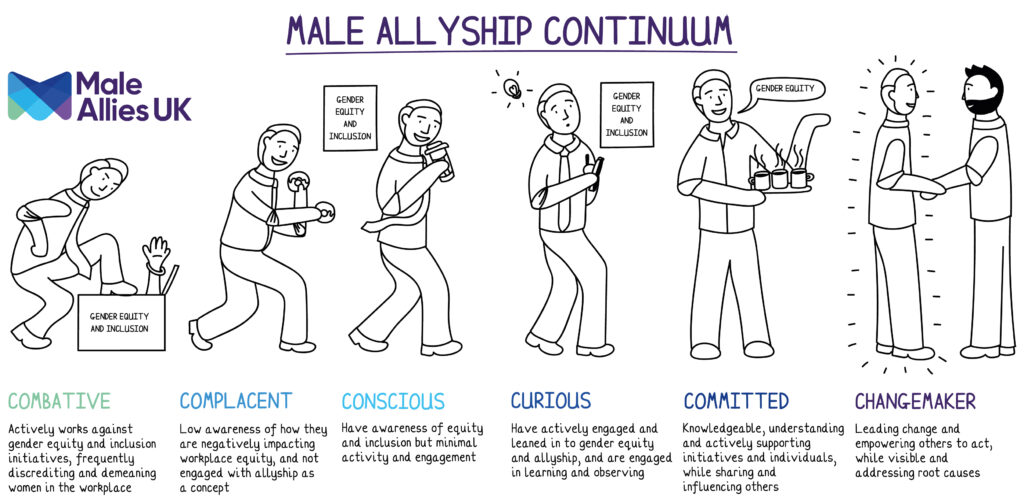
1. The male allyship continuum
Allyship is a journey, not a label.
Men don’t become allies overnight. They move through recognisable stages – from disengagement or defensiveness, through awareness and curiosity, towards commitment and leadership.
Understanding where someone is on the continuum allows organisations to:
- Meet men where they are, not where they “should be”
- Avoid shaming or performative pressure
- Design development that actually sticks
This is how we replace compliance with growth.
2. Positioning as a male ally
Knowing when to step forward, sideways, or back.
One of the most common allyship mistakes is mis-positioning:
- Speaking when listening is needed
- Leading when partnership is required
- Disappearing when influence is necessary
Positioning is a core allyship skill. It helps men read context, power, and impact so they can act in ways that support inclusion rather than undermine it.
Transformative allies don’t ask “What should I say?”. They ask “What does this moment need from me?”
3. Power literacy
Understanding how power really works – and how to use it responsibly.
Power is present in every allyship moment, whether it’s acknowledged or not.
Power literacy helps men:
- Recognise formal and informal power
- Understand how influence shapes safety, credibility, and risk
- Avoid accidental dominance or performative withdrawal
- Use power to protect, amplify, and redistribute opportunity
Without power literacy, allyship becomes either timid or overbearing. With it, allyship becomes intentional, ethical, and effective.
3. Allyship drift and sustainment
Why allyship fades – and how to keep it alive.
Even committed allies can drift. Not because they stop caring but because:
- Mistakes aren’t processed well
- Confidence erodes
- Organisational signals become unclear
- Allyship becomes emotionally costly
- Silence starts to feel safer than action
Our Allyship Drift and Sustainment model identifies:
- Early warning signs of disengagement
- The conditions that keep allyship active, healthy, and credible
- How organisations can intervene before allyship fades
Sustainable allyship isn’t about perfection. It’s about supporting people to stay in the work.
5. Allyship infrastructure
Allyship doesn’t live in individuals – it lives in systems.
When allyship relies on personal bravery alone, it will always be fragile.
Allyship Infrastructure is the idea that organisations must intentionally design:
- Norms that legitimise speaking up
- Leadership signals that protect allies
- Processes that distribute allyship fairly
- Language that reduces fear and confusion
- Feedback loops that enable learning, not punishment
This is how allyship becomes part of how the organisation works, not something a few people carry.
What makes the MAUK approach different
We don’t treat male allyship as a one-off training session, a PR narrative, a compliance requirement or a personality trait. We treat it as a capability.
That means developing skills over time, supporting men emotionally and practically, grounding action in evidence and lived experience, protecting women and marginalised groups from doing all the labour and designing systems that make the right behaviour easier.
Our work is informed by leading academic research on allyship, motivation, power, and organisational culture – but translated into real-world practice that leaders and teams can actually use.
Who this work is for
Our framework supports:
- Organisations serious about gender equality and inclusion
- Leaders who want allyship that strengthens performance, not creates risk
- Men who care but don’t want to get it wrong
- Women and marginalised groups who want change without carrying the burden
Whether you’re at the start of this journey or trying to re-energise stalled efforts, sustainable allyship is possible – when it’s designed properly.
Moving from intention to impact
Male allyship isn’t about being perfect. It’s about being present, responsive, and accountable – over time.
At Male Allies UK, we help organisations build allyship that:
- Holds under pressure
- Adapts as people grow
- Earns trust rather than demands it
- And delivers real cultural change
If you’re ready to move beyond good intentions and build allyship that lasts, we’re ready to work with you.
Your questions answered
What is sustainable male allyship?
Sustainable male allyship is allyship that continues over time, adapts to context, and is supported by organisational systems – not just individual motivation.
Why does male allyship often fail?
Male allyship fails when men lack confidence, clarity, or support; when power isn’t understood; and when organisations rely on individual courage instead of infrastructure.
How do Male Allies UK approach allyship differently?
At Male Allies UK, we treat allyship as a capability – combining evidence-based frameworks, skills development, and system design to make allyship effective and lasting.