At Male Allies UK, we hear it often: “I want to help create equality, but what does allyship mean for me?”
It’s a fair question – and an important one. For too long, men have been told that gender equality is something to support from the sidelines rather than something that can enrich their own lives. But the truth is different. Allyship isn’t self–sacrifice – it’s self–development. When men practise allyship, they become better leaders, colleagues, friends, and partners. They think more broadly, connect more deeply, and live with greater authenticity. It’s not about losing ground; it’s about gaining growth.
The ways allyship benefits men, both personally and professionally
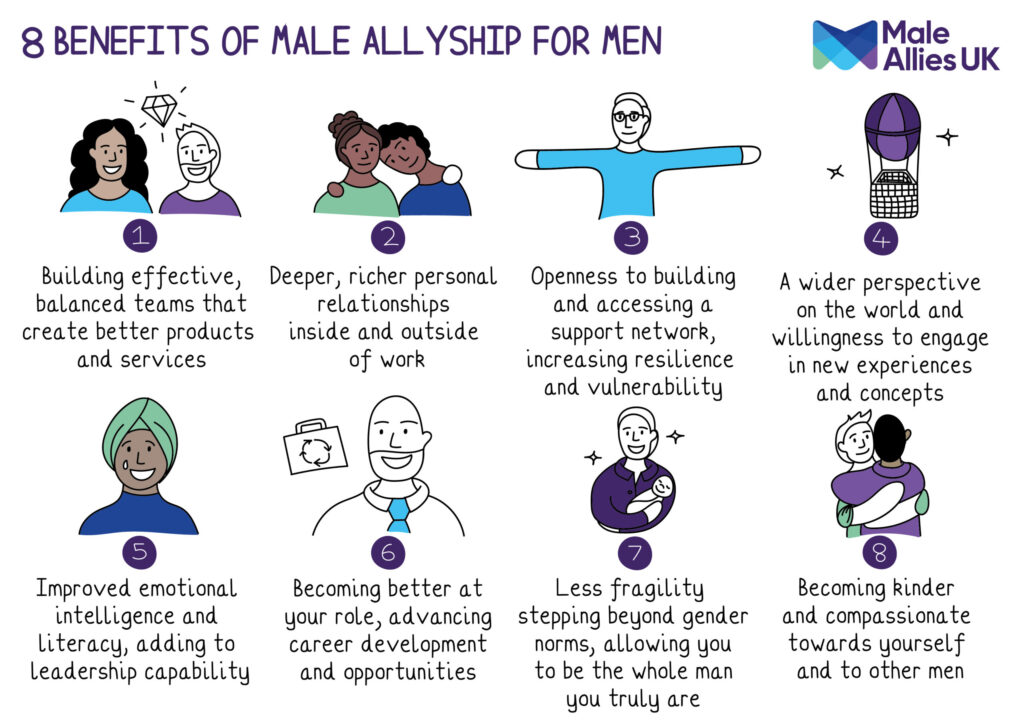
1. Building effective, balanced teams that create better products and services
Inclusive teams don’t just perform better – they think better. When men champion gender balance, decision-making improves, creativity expands, and groupthink recedes. Diverse perspectives challenge assumptions, leading to products and services that genuinely reflect the people they’re made for.
In our work with clients, we see that men who model inclusion elevate the performance of entire teams. They ask different questions, spot potential in others, and help surface unseen talent. Allyship becomes a leadership strategy – one that strengthens outcomes and relationships at the same time.
When inclusion sits at the centre, excellence follows.
2. Developing deeper, richer personal relationships – inside and outside of work
Allyship isn’t confined to the office. The same listening, empathy and curiosity that make inclusive colleagues also make better partners, parents and friends. As men learn to share space rather than occupy it, conversations shift. They become more honest and less transactional. Colleagues feel heard; partners feel supported; friendships deepen.
It’s one of the most rewarding transformations we witness – when a man realises that the same habits that create equality at work also create intimacy at home. Inclusion and connection turn out to be the same skill, practised in different rooms.
3. Opening up to support networks – building resilience through connection
Traditional masculinity often equates independence with strength. Yet isolation is one of the biggest pressures men face.
Allyship creates permission for connection. When men engage in conversations about equality, care, or vulnerability, they discover that they’re not alone – and that strength grows in company, not solitude. Men who practise allyship build new kinds of professional and personal networks. They find peers who value honesty, emotional literacy, and accountability. These connections become a form of resilience – a community that sustains rather than competes.
Allyship reminds men that asking for help isn’t weakness; it’s wisdom.
4. Gaining a wider perspective on the world
Allyship expands the way men see and interpret the world. Listening to experiences beyond their own reveals how systems, privilege, and culture shape opportunity. This shift in perspective builds empathy and strategic awareness – two qualities that define modern leadership. It helps men recognise patterns, challenge assumptions, and navigate difference with confidence rather than fear.
Perspective doesn’t dilute ambition; it refines it. Men who understand complexity lead with clarity. They learn that equity isn’t an abstract principle – it’s a more accurate lens on reality.
5. Improving emotional intelligence and leadership capability
Inclusive leadership depends on emotional intelligence – the ability to recognise, understand and manage emotions in oneself and others.
Allyship develops exactly that. It teaches men to pause before reacting, to read emotional cues, and to communicate with empathy. Those skills strengthen relationships, reduce conflict, and improve collaboration. Leaders with high emotional literacy create safer, more engaged teams. They make better decisions under pressure because they can manage both data and dynamics. And as they model that behaviour, others learn to do the same.
Allyship doesn’t soften leadership – it sharpens it.
6. Advancing career development and opportunities
In workplaces that prize collaboration, adaptability and inclusive thinking, allyship has become a leadership advantage.
Men who practise allyship are trusted more widely. They’re seen as fair, approachable, and emotionally intelligent – qualities that attract diverse talent and strengthen reputation. Executives who lead inclusively are more likely to be chosen to manage complex projects and represent organisations externally.
Allyship builds professional credibility. It signals self–awareness and ethical confidence – the hallmarks of leadership in the modern world. Far from being a diversion from success, allyship is now a prerequisite for it.
7. Building resilience and authenticity – stepping beyond gender norms
Many men have been conditioned to measure worth through control, achievement or stoicism. That narrow version of masculinity can make vulnerability feel risky and authenticity feel unsafe.
Allyship helps dismantle that internal armour. By practising empathy and openness, men discover new forms of strength – the kind that allows honesty, learning and repair. They become more resilient because they are no longer performing; they’re participating.
When men step beyond rigid gender norms, they stop chasing perfection and start embracing wholeness. The result is less fragility, greater adaptability, and a deeper sense of peace with who they are.
8. Becoming kinder and more compassionate – towards yourself and other men
Perhaps the most unexpected benefit of allyship is how it changes relationships between men.
As men work to create inclusion, they start showing each other more understanding. Competition gives way to collaboration; silence around stress gives way to conversation. Kindness becomes not an exception but an expectation.
That compassion extends inward too. Men who practise allyship learn to forgive themselves for past mistakes, to accept growth as a process, and to support rather than judge. Kindness, it turns out, is contagious – and culture follows its lead.
The bigger picture: allyship as human development
Each of these benefits reinforces the others:
– Men who build balanced teams strengthen their leadership,
– Learn to listen deepen their empathy,
– And unlearn restrictive norms rediscover authenticity and compassion.
Allyship connects the personal with the professional. It turns leadership from performance into partnership. It gives men the tools to lead with integrity in every arena of life.
At Male Allies UK, we see this transformation every day – in boardrooms, factories, and virtual teams. Men who begin their allyship journey for organisational reasons often discover something far more profound: that equality liberates them too. When men engage fully – listening, learning, and leading – everyone benefits. Workplaces thrive, relationships strengthen, and cultures evolve.
Join us in building a culture of balanced leadership
Through our training, coaching and consultancy, we help organisations turn allyship from an individual choice into a collective capability.
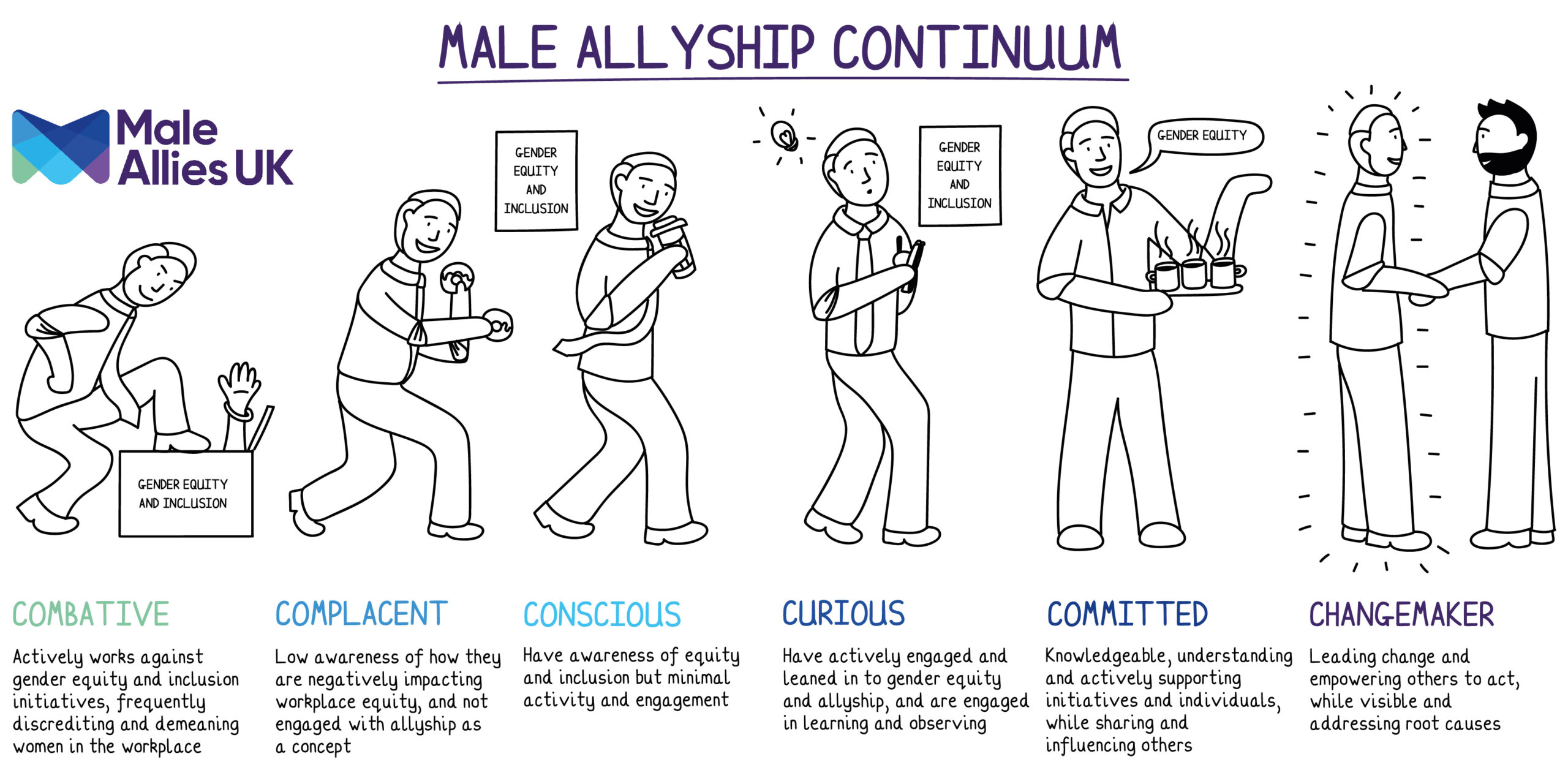
Our frameworks – from the Male Allyship Continuum to our CAUSES framework and the 8 Tenets of Male Allyship – guide men through awareness, skill-building and sustained practice.
Because when men grow through allyship, leadership itself changes. If your organisation is ready to unlock the full potential of inclusion – for everyone – we’re ready to help.