
Words shape workplaces. They influence who gets hired, promoted, mentored, and trusted. They reveal what we value – and who we value. Yet even in 2026, gendered language remains one of the most persistent and overlooked barriers to equality.
From job descriptions that subtly code for ‘masculine’ traits to performance feedback that labels women as ’emotional’ and men as ‘decisive’, the words we use quietly sustain bias.
At Male Allies UK, we see this every day in our work with organisations – and we know that tackling gendered language is one of the fastest, most effective ways to build fairer cultures. Because inclusion isn’t only about who’s in the room. It’s also about the language spoken once they get there.
The invisible weight of words
Language doesn’t just describe reality – it creates it.
When we call men ‘assertive’ and women ‘aggressive’, or describe one colleague as a ‘natural leader’ and another as ‘a good team player’, we’re reinforcing deep-seated assumptions about competence, confidence, and character.
These patterns aren’t always intentional. They’re inherited – absorbed from decades of social conditioning that link leadership with masculinity and care with femininity. But even unconscious language has real consequences. It shapes how people are evaluated, paid, and promoted.
Bias can sound polite. It can even sound like praise. But beneath the surface, it signals who belongs – and who doesn’t.
The data tells the story
According to Textio’s 2024 Launguage Bias in Performance Feedback report, which analysed more than 23,000 pieces of workplace feedback, gendered language remains widespread and measurable.
The findings are stark:
- Women receive 22% more personality comments than men do – words like ‘caring’, ’emotional’, or ‘helpful’
- Men receive more ‘standout’ adjectives than women – men are 3x more likely to be called ‘ambitious’ and ‘confident’ than women
- Women’s feedback is more likely to be linked to teamwork and support, even in leadership roles
- Women are negatively stereotyped up to 7x more often than men – words like ‘unlikeable’, ‘difficult’, or ’emotional’
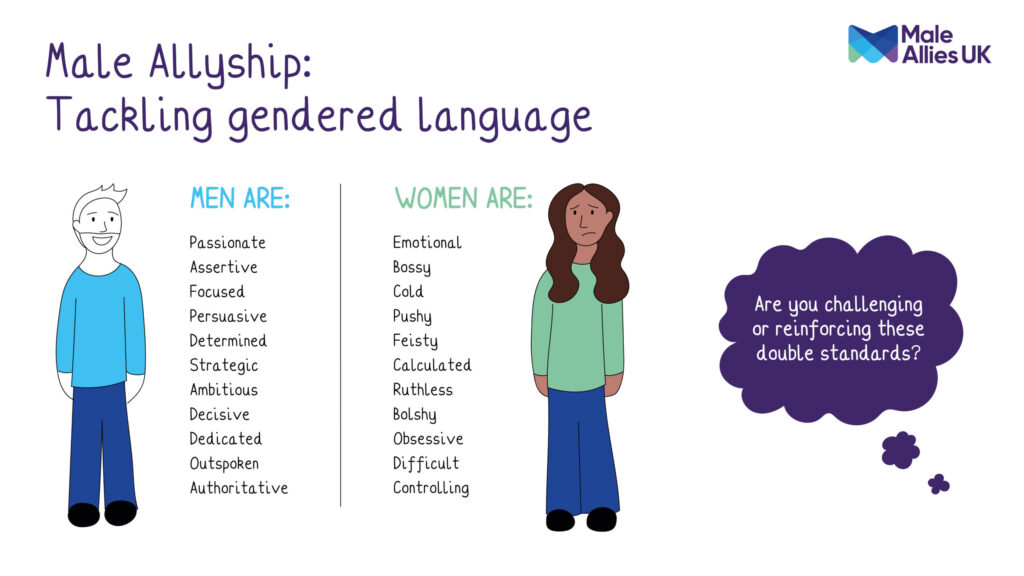
Textio’s conclusion is clear: feedback bias mirrors societal bias. Men and women can behave in the same ways at work but be labelled very differently due to gender bias. As the cartoon below shows, men are praised for being ‘assertive’ while women are labelled as ‘bossy’, men are ‘ambitious’ while women are ‘ruthless’, and so on.
This matters because language isn’t neutral. It feeds into performance ratings, pay decisions, and confidence. If managers and teams consistently attribute negative traits to assertive, ambitious women while praising ‘exceptional’, ‘driven’ men, then pipelines are going to be more male.
Gendered language isn’t just about adjectives
It’s not only about how people are described – it’s about the stories we tell through language.
Consider the difference between these statements:
- ‘She got lucky with that project’
- ‘He really drove that success’
Or in job adverts:
- ‘We’re looking for a strong, competitive, results-driven professional’
- ‘We’re looking for a collaborative, supportive team player’
The first signals a ‘masculine-coded’ environment. The second, ‘feminine-coded.’ Neither is inherently better – but research shows that women are less likely to apply for roles framed in masculine-coded terms, while men are not discouraged by feminine-coded language.
That asymmetry means masculine-coded language keeps reproducing itself. This is why, even with strong inclusion policies, cultures can still feel exclusionary because bias hides in the everyday words.
The cost of not addressing it
When gendered language goes unchallenged, it does three things:
- It limits opportunity. People are hired, promoted, or developed according to coded assumptions rather than capability
- It damages belonging. Individuals stop seeing themselves reflected in the language of success
- It distorts data. Performance metrics built on biased feedback misrepresent talent
Over time, that erodes trust. Employees begin to believe inclusion is only a slogan, not a lived value.
The good news? Once you can see it, you can change it.
How we tackle gendered language in practice
At Male Allies UK, we approach language change as part of transformative allyship – the shift from intention to impact.
Here’s how we help organisations and leaders make that change:
1. Make bias visible
We start with awareness. Teams review real examples of language from job adverts, performance reviews, and everyday feedback. We use Textio-style analysis tools to show the patterns people miss – and the hidden assumptions behind them.
Seeing it on paper is often the “aha” moment. People realise bias isn’t abstract – it’s in the words we use daily.
2. Reframe, don’t reprimand
The goal isn’t guilt; it’s growth. When we find biased phrasing, we work together to reframe it:
- From ‘She’s emotional’ to ‘She shows passion for her work.’
- From ‘He’s dominant in meetings’ to ‘He takes up space – how can we make room for others?’
Language correction isn’t policing – it’s modelling.
3. Embed inclusive feedback training
We train managers to use consistent, evidence-based language when giving feedback. We introduce prompts like:
- ‘What specific behaviours are you describing?’
- ‘Would you use this language if this person were another gender?’
- ‘Does this feedback measure skills, or personality?’
These small shifts make big cultural change.
4. Audit systems, not just sentences
Language bias doesn’t exist in isolation. It’s reinforced by systems – how feedback is gathered, who reviews it, and how it’s weighted.
We help organisations design structures that counteract bias:
- Shared calibration processes
- Cross-gender review panels
- Language neutrality checks in recruitment and performance management
Systemic fairness begins with linguistic awareness.
5. Connect language to allyship
For men, especially those in leadership, addressing gendered language is a tangible entry point into allyship. It’s not about over-correcting or self-censoring – it’s about curiosity and accountability.
When men learn to spot gendered language in themselves and others, they start to see bias everywhere – and more importantly, how to challenge it. Allyship becomes linguistic activism: using words to include, not exclude.
From bias to belonging
The way we talk about people shapes how we treat them. Every ‘he’s strategic’ and ‘she’s supportive’ reinforces a subtle hierarchy of value.
But when we become conscious of language – when we see it as a living system of inclusion – we create workplaces where everyone can belong without translation. At Male Allies UK, we believe language is the frontline of culture. Changing it isn’t cosmetic. It’s catalytic.
Because when the language of leadership becomes genderless, leadership itself becomes limitless.