
Positioning As A Male Ally
When to step forward, step sideways, and step back
Every allyship moment carries a choice.
Do I speak up – or hold back?
Do I take the lead – or share the space?
Do I act – or listen first?
At Male Allies UK, we describe this as the art of positioning: the ability to sense what’s needed, where you stand, and how your presence helps, or hinders, progress.
Because allyship isn’t a single posture. It’s a movement between them. Knowing when to step forward, step sideways, and step back is what separates performative allies from transformative ones.
Why positioning matters
Many men who want to be allies hesitate because they fear getting it wrong – overstepping, saying the wrong thing, or being seen as performative. Others try too hard to “lead” inclusion and end up taking up space that wasn’t theirs to occupy.
Both extremes come from the same root: uncertainty about position. But here’s the truth – allyship isn’t about perfection. It’s about awareness. When you understand the dynamics of space, voice, and influence, you can adapt to what the moment needs.
That’s positioning in action.
Step forward: use your voice and influence
There are moments when silence costs more than discomfort.
Stepping forward means using your voice and your privilege to intervene, challenge, and protect – especially when bias or exclusion occurs in real time. It’s about interrupting a sexist joke, calling out double standards, or questioning who isn’t in the room. It’s about standing up when it would be easier to stay seated.
This is courage in motion – the first of the 5 C’s of Allyship.
What “stepping forward” looks like
- Challenging exclusionary behaviour (“I don’t think that’s fair – can we rethink how we’re framing this?”)
- Asking who’s missing from a project or panel and ensuring they’re included
- Taking responsibility in moments of bias (“That wasn’t handled well – let’s make it right.”)
What to avoid
Stepping forward doesn’t mean speaking for women or other underrepresented groups. It means creating safety, not stealing focus.
If your voice dominates, or your intervention centres you, it’s not allyship – it’s a performance.
The key question
➡ Am I using my influence to protect or project?
Step sideways: partner, share power, and learn
True allyship isn’t only about advocacy – it’s about partnership.
Stepping sideways means moving alongside women and other marginalised colleagues as peers, collaborators, and co–conspirators. It’s about learning together, not leading alone.
This position is grounded in curiosity and compassion – two more of the 5 C’s – and it’s where relational trust grows.
What “stepping sideways” looks like
- Sponsoring women for opportunities – and then working with them to remove systemic barriers
- Co-leading projects or panels, making space for shared leadership
- Asking for feedback on your allyship: “How did that land? Is there anything I could do differently?”
This is where male allies learn that inclusion isn’t an individual act – it’s a collaborative process. It’s also where you build the muscle of humility: recognising that good intentions aren’t always good impact.
What to avoid
Don’t confuse partnership with protection. Women don’t need rescuing – they need resources, recognition, and respect.
And don’t mistake feedback for criticism. When someone trusts you enough to offer it, that’s an invitation to grow.
The key question
➡ Am I standing beside others – or in their way?
Step back: yield space and amplify others
There are also moments when the most powerful thing you can do is step back. That means intentionally yielding the floor, deferring to those with lived experience, and using your influence to amplify voices that aren’t heard often enough.
This is where commitment and consistency – the remaining C’s – come in. Allyship isn’t a constant spotlight on yourself. It’s a constant awareness of who else deserves to be seen.
What “stepping back” looks like
- Deflecting praise to the people whose work made the difference
- Turning the question to others in meetings: “I think she raised that idea earlier – let’s build on it”
- Using your credibility to open doors, then stepping out of the frame
What to avoid
Stepping back doesn’t mean disappearing, it means de-centring. You’re still in the work – just not always at the centre of it.
Avoid performative self-removal (“I’ll stay silent so others can speak”) if it means withdrawing from responsibility. The point is to share space, not vacate it.
The key question
➡ Whose voice needs to be heard more than mine right now?
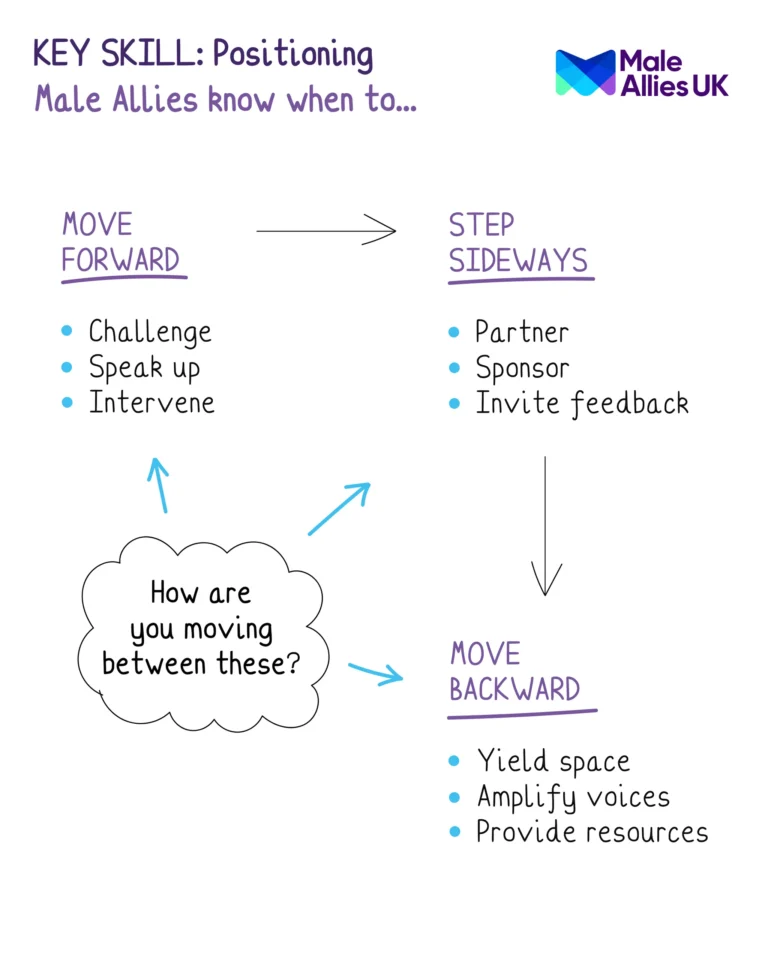
Knowing which position to take
The difference between stepping forward, sideways, and back isn’t a formula – it’s a practice.
Here are some examples:
Situation: Harmful behaviour or exclusion in real time
Position: Step forward
Example: Interrupt bias, reinforce boundaries, ensure safety
Situation: Collaboration or joint advocacy
Position: Step sideways
Example: Partner, co-create, invite feedback, share influence
Situation: Representation or visibility moments
Position: Step backwards
Example: Amplify voices, yield space, provide access and support
The power of positioning in practice
When men learn how to position themselves, three shifts occur:
- Cultural safety increases – because bias is challenged early and consistently
- Collaboration deepens – because men become trusted partners, not saviours
- Leadership expands – because inclusion becomes an instinct, not an instruction.
In our work with organisations, we often see this turning point: when men stop asking, “What should I say?” and start asking, “What does this moment need from me?”
That’s the sign of a transformative ally.
A living posture
Being a male ally isn’t a fixed role – it’s a living posture. Sometimes you’ll misjudge it. You’ll speak when you should have listened. You’ll hold back when you should have stepped up. That’s part of the process.
What matters is your willingness to notice, reflect, and adjust – again and again. Because allyship isn’t about being right. It’s about being responsive. And when more men learn the rhythm of stepping forward, stepping sideways, and stepping back – workplaces start to breathe differently.
They become more balanced. More honest. More human. That’s positioning, and that’s progress.
Your questions answered
What does “positioning” mean in male allyship?
It’s the awareness of when to step forward to challenge bias, step sideways to partner and learn, or step back to amplify others – using influence consciously
How can men know when to speak up or stay silent?
By asking, “What does this moment need from me?” and choosing the position that supports inclusion, not ego.
Why is stepping back important for allies?
Because allyship isn’t about visibility – it’s about impact. Stepping back ensures others’ voices are heard, credited, and supported.