
Allyship didn’t begin as a buzzword. It began as a movement – one built on courage, reflection, and connection across gender lines.
At Male Allies UK, we see allyship as part of a much longer story – one shaped by generations of people challenging inequality, expanding opportunity, and redefining leadership. Each step has brought men and women closer to partnership, not polarity.
To understand where male allyship is heading, it helps to look at how far we’ve come
Here are six landmark moments in the evolution of male allyship – from early advocacy to a new era of shared responsibility, culminating in our own National Allyship Summit: From Gender Division to Gender Dialogue.
1. 1848 – Men join the call at Seneca Falls
The first organised women’s rights convention in Seneca Falls, New York, is often remembered for its female leaders – but it also marked one of the earliest recorded instances of men publicly aligning themselves with gender equality.
Frederick Douglass, an African American abolitionist, journalist, and former slave, stood beside Elizabeth Cady Stanton and Lucretia Mott to demand women’s suffrage and social inclusion. His presence mattered. Douglass argued that equality could not be partial – that no liberation is complete until it is shared. That act of solidarity set an early precedent for male allyship: using privilege to amplify, not overshadow.
It was the beginning of men showing up – not as voices of authority, but as partners in progress.
“All that distinguishes man as an intelligent and accountable being, is equally true of woman; and if that government is only just which governs by the free consent of the governed, there can be no reason in the world for denying to woman the exercise of the elective franchise, or a hand in making and administering the laws of the land.”
Frederick Douglass, 1848
2. 1918 – The first generation of policy allies
The early 20th century saw the beginnings of legislative recognition for women’s rights – from property and education to voting and work.
But behind every change in law were men who challenged their peers, questioned political norms, and used their influence to shift policy. In the UK, MPs like John Stuart Mill and Henry Fawcett had already championed women’s suffrage decades earlier, but by 1918, a broader coalition of men inside government helped pass the Representation of the People Act – a partial but pivotal step toward equality.
These men weren’t perfect allies – many still carried contradictions – but they modelled a truth that endures: systemic change requires those in power to share it. Their actions mark the transition from personal support to political allyship.
“Bad men need nothing more to compass their ends, than that good men should look on and do nothing.”
John Stuart Mill, February 1867
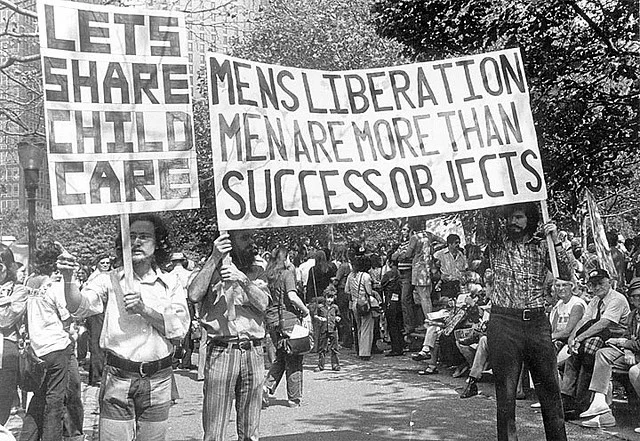
3. 1960s-70s – The rise of men’s consciousness movements
By the late 1960s, women’s liberation movements had spread globally. Alongside them, a new kind of men’s movement emerged – one that asked not “How can we help women?” but “What does gender equality mean for us?”
Groups like the Men’s Liberation Movement in the UK and US began questioning rigid gender roles, emotional repression, and the societal expectations placed on men. It was a radical shift. For the first time men were exploring how patriarchy limited them too – how empathy, care, and vulnerability had been written out of masculinity.
These movements laid the emotional groundwork for modern allyship. They helped redefine strength, not as dominance, but as connection.
4. 1995 – The Beijing Declaration and the globalisation of allyship
The 1995 UN Fourth World Conference on Women in Beijing marked a new global phase for gender equality – and a more visible call for men’s engagement.
The Beijing Platform for Action recognised that equality could not be achieved by women alone; men must be partners in dismantling inequality. It reframed gender equality from a “women’s issue” to a shared social and economic imperative. From that point forward, international development agencies, governments, and civil society organisations began actively involving men in gender programmes – birthing terms like men for gender equality and engaging men and boys.
Male allyship moved from moral argument to global strategy. It was no longer about helping women succeed; it was about creating a world that works for everyone.
25. Encourage men to participate fully in all actions towards equality.
Beijing Declaration and Platform for Action, 1995
5. 2014 – #HeForShe and the modern allyship era
When UN Women launched HeForShe in 2014. Supported by then-UN Secretary-General Ban Ki-moon and championed by Emma Watson, it brought male allyship into mainstream consciousness.
The campaign invited men worldwide to take public pledges for gender equality and, more importantly, to reflect on how their influence could drive change. CEOs, heads of state, and global institutions joined – signalling that allyship had entered the leadership agenda. But HeForShe also revealed a challenge: pledges are only powerful when followed by practice.
It sparked the next evolution: from symbolic gestures to structural commitment, and from awareness to accountability. This shift set the stage for organisations like ours to emerge – focusing not only on engaging men, but on equipping them.
6. 2026 – Male Allies UK launches the first National Allyship Summit
That evolution leads us to now.
In 2026, Male Allies UK will host the country’s first National Allyship Summit, uniting organisations, practitioners, and changemakers around the theme: From Gender Division to Gender Dialogue.
This moment represents a new chapter in the story of allyship – one defined not by polarity, but by partnership. The Summit will bring together men and women, leaders and learners, researchers and practitioners, to explore how allyship transforms workplaces, leadership, and systems.
It’s not just about awareness – it’s about architecture: how to embed allyship into culture, accountability, and policy. The theme reflects what we see every day in our work: that progress depends on conversation, not confrontation.
This is the moment where allyship becomes not an idea or an initiative, but an identity – one that defines how we lead and live.
The future of allyship in the UK
At Male Allies UK, we believe this next era of allyship is defined by shared accountability, intersectional awareness, and systemic design.
We’ve seen what happens when men engage not out of guilt, but out of growth – when they understand that equality benefits everyone. And together, we can move from division to dialogue, and from dialogue to lasting change.